Thank You Raja Petra Kamarudin
I would like to say a very big Thank You to Raja Petra Kamarudin for publishing my article in his blog.
www.malaysia-today.net in the Guest Columnist section.
Honestly, I got a buzz out of it. Feel on top of the world!
I would like to say a very big Thank You to Raja Petra Kamarudin for publishing my article in his blog.
www.malaysia-today.net in the Guest Columnist section.
Honestly, I got a buzz out of it. Feel on top of the world!
The game is who blink first, he or she loses.
For the past few years, Iran has been researching into alternative energy, which is nuclear energy to quench its energy hungry populace. Nuclear energy is relatively simple, and relatively cheap to produce. Western Europe and former USSR have been using this technology for a few decades, and being cheaper than other energy sources, they enjoy faster economic growth and command comparative advantage in the sixties and the seventies.
In the past, this old technology produces a byproduct that can be made into nuclear bomb. As such Western countries are wary of any country that acquires capabilities to enrich plutonium to fuel nuclear reactor.
Iran has rights to develop nuclear energy, just as USA, Western Europe and Russia had. Iran may have a lot of oil to use as energy, but it also need alternatives. Nuclear energy could fit the bill in winter, while solar energy could be harnessed in summer. I see no reason why the Bush Administration being suspicious, that Iran should might develop nuclear weapon.
In economics, a country could stay ahead from other countries if it still has comparative advantage in whatever it is doing best. Having cheaper energy, skilled populace, and bountiful resources could contribute tremendously towards a country’s comparative advantage. In Iran’s case, it already has bountiful oil for export, educated populace and much to the consternation of the West, an Islamic country with anti West leadership.
From Western viewpoint, if Iran could be self sufficient in energy needs, (Iran could develop nuclear energy as an alternative to solar and oil) educated and resourceful populace who could develop its own indigenous technologies for its own needs, then Iran could be the new leader in the Islamic world, without any supportive crutch from the West, unlike Saudi Arabia, Turkey or Pakistan. Look at Saudi Arabia, even though it is self sufficient in energy, it import everything else, its populace are too dependable towards foreign worker even to do household chores. The same can be said of other Gulf States. Does Turkey or Pakistan have sufficient energy and resources to stand on its own? Nope. The key to self sufficiency is energy. With cheap energy, you could produce food and almost all your needs, provided that your country has skilled and educated populace.
Iran has already shown its capability in defense technology, Western media have an eyeful of that the other day during Iran’s military exercise in the Persian Gulf. So Bush Administration starts asking, what else is Iran capable of?
I believe Iran is guilty of goading the West into current situation. President Ahmedinijad had made statements denying the holocaust and that Israel should be wiped off from the face of the earth. Furthermore, Iran had military exercises since last month, showing off its guided missiles.
Is Iran ready for war? I believe so, otherwise why would they do such things? Iran wanted to do that to be relevant in the Islamic world.
Then, is Bush Administration ready for war? I think not, not until the Iraqi business is concluded, then it will need another war. War is a good business for USA. It keeps the economy humming, producing vehicles, weapons and keeps the population focused on the war, forgetting their dismal performance at home. Look how much defense goods that America produces since the war began, and the surplus food that they shipped to Iraq. War abroad keeps the economy growing and healthy. Since 2001 “war on terror” in Afghanistan, America has been at war, first with the Talibans on pick-up trucks, and now with the Iraqis strapped with grenades.
Why doesn’t Bush Administration pick North Korea, Liberia, Sudan or Sierra Leone where there have been massacres lately? Those countries are inconsequential, no resources, and no oil. Bush Administration has found a way to keep the economy growing and healthy, make war, and war with an oil producing country. Oil prices will stay high, Gulf States will make a lot of money, which will be invested in America and Europe, and American companies will continue producing defense goods and keep American economy humming and healthy.
The real axis of evil, America, Europe and rich Gulf States. Why do I say Gulf States guilty as well? As Bill Clinton said sometime ago, it could invest in their poorer neighbours and spread their wealth where it is needed most, those poorer Middle Eastern countries, Indian subcontinent and Africa. If money doesn’t flow back to America and Europe, they wouldn’t have enough clout to throw their weight about, and threaten war against Iran.
Noor Yahaya Hamzah
It was a "get your cronies richer" scheme to start with, legacy of Mahathir's era. I could imagine the millions and billions that goes to some people pockets getting contracts and subcontracts.
Yes we have heard that before.
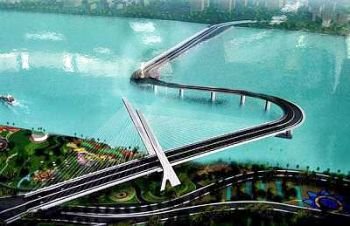
As for making JB a marina and pleasure boat haven, who benefit from that? The rich of course, once they get the contract, they will have more money to splash about, including pleasure boats.
This shows that Abdullah Badawi intent of undoing the legacies of Mahathir's era. He want to show that he is not shackled by Mahathir's legacies and his men in cabinet.
Or is it? Najib, What say you?
As for the new CIQ complex, I think its a waste of money as well. I think its pointless to do immigration check at JB in the first place, the same with customs. Why dont we just let everyone free entry? No need to check or stamp passport.
Then we could say to Singaporean that once upon a time Singapore is part of Malaysia, and may one day will be part of Malaysia again.
Send the chilling shiver up their backs!
Will the saving from petrol subsidy be channelled to right places? That is the RM4.4billion question. So far I have read that the savings from removing a portion of petrol subsidy will be used to build and improve public transport system. That is okay to certain extent, if it does not involve awarding more mega projects to well connected indivuduals.
What I dont want to hear is another electric train project to nowhere, and more cronies bagging the BOT contract.
The keyword for efficient and popular public transport system in Malaysia's urban areas is "cheap and effective".
Train system would cost a lot of money and demand higher fares, it uses a lot of land, which is scarce resources. I would suggest limiting the number of single occupant cars entering major cities to start with, to reduce congestion. Then create dedicated bus lanes on major bus routes. (Any car using this lane shall be fined) And if the city could afford it, subsidize free bus service within central city to encourage commuters to leave their vehicles at home. Existing train service should also be subsidized to keep fares low.
Instead of controlling the price of bus fare, we should subsidize the bus companies, by tendering the routes. Say, KL-Klang route, buses should depart every 3 minutes during peak times and every 6 minutes during off peak times. Bus companies would then tender their price for providing this service, taking into account the revenue collected from bus fares, staff wages, maintenance costs, capital costs and fair profit. Government could fix the bus fare, say at RM2.
Bus company then calculate the projected revenue less costs, and if the route is unprofitable, bus company then tender for subsidy to make the route profitable. This way the frequency of bus service is assured, and the bus driver wouldnt have to wait until the bus is full before starting, understandably they want to maximise revenue, hence their pay packet.
In this way, the government avoid capital cost of setting up the service (i.e. buying buses etc) and firms could invest in transport business knowing the certainty of future profits. Current government method of controlling prices (in this case bus fare) without handing out subsidies only hindersfirms investment in public transport system. No one would invest money in any undertaking or enterprise if there is no profit to be had. As such, existing bus companies run down their capital, (e.g. old buses not replaced) and in the future the public would lose the service.
Same method could be applied for train service - albeit at a higher price.
What I am suggesting here is cheaper more cost effective way of providing public transport system. Of course we could build a train system criss crossing the peninsula, but the cost is prohibitive. Unless the project has other benefits beside reducing congestion - like giving lifeline to construction sector.
I believe if we do it this way, there would still a lot of money left for other projects, like providing low cost housing for the poor and giving income top up for low income group.
The less government getting itself involved in business the better, so that it can concentrate more on governing, making the rules fair and distributing the incomes of its citizens as evenly as possible.
Here is an interesting article concerning water problem in Malaysia.
I like the suggestion that we all should take example from our forefathers, collect and store rainwater for our use.
I grew up in a village, back then we didnt have piped water. So my parent collect rainwater into big drum and tempayan. Those water would be used for drinking and cooking food. As for washing and ablution, we used water from our well. Our land was formerly paya bakau wetland, so the ground water is salty.
Malaysia has high precipitation, but sadly most of the water is wasted down the drain. Collection of rain water could help in reducing our dependence on water companies.
Brace for water shortages
By DEVID RAJAH AND SA’ODAH ELIAS
PETALING JAYA: Many of the 189 river basins nationwide are in dire straits.
This warning from Department of Irrigation and Drainage director-general Datuk Keizrul Abdullah may sound extreme, but that is the reality of today.
Parts of the country, particularly the Klang Valley, he said, would be facing a water crisis as early as next year unless the agencies concerned and the people started taking serious care of rivers.
WASTE EVERYWHERE: A collector scooping up plastic bottles discarded into Sungai Selangor. The boom which stops rubbish from flowing downstream into the nearby Puncak Niaga Water Intake Station has not been cleaned for months.
“On one hand, we have river basins overburdened by problems brought about by over- development. On the other hand, the number of people dependent on these rivers keeps rising because they are attracted to the development.
“That is a recipe for disaster,” he said.
Keizrul described the problem facing the country as “a classic situation where rivers are under pressure from development.”
“We get sedimentation, we get floods, we get pollution, yet we are also taking more water from rivers, so there is less volume and in the process, the pollution gets more concentrated,” he said.
Apart from the Klang Valley, he said, water supply crises were also imminent in Penang and Malacca.
According to him, the situation was compounded by dry weather flow problems and inefficient management of water resources.
“Dry weather flow problems are particular to river basins that are over-developed as they have less ground water storage due to drainage systems that efficiently send rainwater direct into rivers and then literally to waste in the sea,” he said.
The increased water run-off – not only in terms of volume but also speed – contributed to flash floods, high sedimentation and shallow rivers, he added
“Unless this problem is tackled, there may come a time when some of our river basins will not even have enough water to reach the sea during the dry season, let alone provide water for household needs.
RIVERSIDE DUMP: Construction debris dumped along Sungai Selangor is also a source of river pollution.
”Some river basins providing clean water to the people are already reaching their limits,” he said.
Water demand for Selangor and the Federal Territories is now 2,500 million litres per day and the figure will double by 2010.
The authorities, Keizrul said, must come up with more comprehensive programmes to rid water catchment areas of polluting industries, introduce better development guidelines and control, and put in place better water management systems.
“And the people must stop treating our rivers like toilets,” he said.
Given the current situation, Keizrul said, it was high time good river management be given high priority as over 97% of the country’s water supply came from rivers while only 3% was sourced from ground water.
In view of the looming disaster, he said, the people must do their part to complement the Government’s efforts by using water efficiently and not treat rivers as dumping grounds.
“For instance, they can start by collecting and storing rain water like what our forefathers used to do and use this for washing and flushing toilets,” he said.
Keizrul also urged the Government to raise water tariffs so that the increased revenue could be used to set up a river fund to rehabilitate rivers.
“Before people get angry with me by claiming that this will burden the poor, let me also suggest that since water is a necessity, let the first 10,000 litres be free, but the tariff for usage beyond that be double the current rates,” he said.
Tomorrow: Floating landfill at Batang Berjuntai
Title: Tun Mahathir’s Solution: Raise Exchange Rate
I admire Tun Mahathir for suggesting a solution of our petrol price hike. It sounds compelling and easy; let our ringgit rise in value, and there will not be any need to subsidize petrol.
Let examine the facts that ours is an open economy with free floating exchange rate to some extent (managed float, whereby Bank Negara intervene to promote stability). There are several ways of raising the real exchange rate some of which I shall outline here:
1. Increase local investment, or in economic terms, fiscal expansion without monetary expansion. Government shall borrow money in local market and invest in infrastructure, school, hospital etc. As a result, interest rate will rise, and foreigners will be attracted to invest in local money market, as money flows in, real exchange rate will rise.
2. Monetary tightening, as opposed to loose monetary policy at the moment. Bank Negara will increase interest rate well above the world market, and again as a result, foreigners will invest in our higher returns, and real exchange rate will rise.
3. Bank Negara would simply bid up our ringgit and spend our foreign reserve, which can be done under the guise of managing our free floating ringgit.
All of the above methods will result in higher exchange rate, but will result in lower export, because higher exchange rate will render our exports less competitive. Our balance of payment might result in deficit in the future. That is still okay, but our uncompetitive firms might also lose business and close down, which would eventually result in higher unemployment.
Another side effect of the first two is higher interest rate, which will result in lower private investment and cool down the economy in the medium term. Individuals would postpone their investment in housing and durable goods (stuff that you have to borrow money to buy), demand slows down and inflation would be lower. Some people in the export sector might lose jobs, as our exports become less competitive.
As for Bank Negara bidding up our ringgit in the foreign exchange market, that is a risky proposition, currency speculators would have a field day once our intention is known.
One possible way to raise exchange rate that is contrary to our commitment to WTO and AFTA is to erect protectionist trade policies such as a ban on imported cars, textile, electronics goods etc. For example a ban on imported beef would result in higher local prices for beef. This in turn would encourage local farmers to produce more beef. Because we saved money on beef which otherwise would have been imported, the demand for net export would rise, hence exchange rate would rise as well. When exchange rate is higher, some export sector would be uncompetitive and lose business. This would result in unchanged net export position. Resource allocation would shift to protected industries. Instead of moving forward and liberalizing our trade policies, we would be moving backward.
Whether the government spend money subsidizing our petrol or we spend a larger chunk of our pay packet, in total sum the country spend the same amount, provided that the total consumption is still the same. Let see this petrol price hike as it is, resource reallocation. We the rakyat have less to spend on other things if we spend more on petrol. If we collectively spend less on chicken, fish and vegetables, while the production of those items stays the same, eventually the real prices of chicken, fish and vegetables would be lower, ceteris paribus.
I would instead suggest to the government to give more help to the poor, needy, disabled and the unemployed. Let’s ask for social welfare payment or at least income top up for the low income group. For example, if a disable person couldn’t work, government should give a living allowance of at least RM800. (I do not know if this is enough living allowance for one person, should it be higher?) As for low income families, government could give a top up for their income, straight to their account.
We should also work toward minimum wage legislation. A worker should get at least RM1200 a month based on 48 hour work week, or RM5.70 per hour. No employer should pay an employee less than that, because that is hardly enough to pay for rent, food and transportation in main urban areas.
Noor Yahaya Hamzah
Email: nooryahaya@yahoo.com
http://nooryahaya.blogspot.com
Title: Minimum Wage and Safety Net.
As the effect of removal of fuel subsidy started to bite into the pay packet of the low income group, the call for transparency into Petronas accounting of profit and where the monies goes, gets louder and more vocal. As Malaysian citizens, we all have rights to know the annual report; after all we are all shareholders. Removing fuel subsidy is like imposing tax, which in this case is like consumption tax, the size increases with the amount consumed. The low income groups are the most affected because fuel costs take a sizable chunk of their income.
I do believe that the decision to increase petrol price is correct, and in time, the government should completely remove the subsidy, but the government should do more to help the lower income group most affected.
I support Lim Guan Eng’s call for government to give money to Malaysia’s poor, in the form of cash grant or social welfare payment for the needy, disabled, unemployed and low income group. The current social welfare payment by Jabatan Kebajikan Masyarakat is too low, the poor and disabled had to supplement their income by begging in the streets. This is the time for the government to show their sincerity about the caring society slogan.
I also would suggest to the government to legislate a form of minimum wage law, set at the rate that is enough to pay for comfortable living for our workers. Given the cost of living in the main urban areas, I would suggest that the minimum wage be set at RM1200 for 48 hour week or about RM5.70 per hour which even at that rate it’s hardly enough to pay for rent, food and transportation.
Would employers be able to afford it? Of course they would say no, but corporate profits reported in the past few years suggest that employers can afford it. Its time that the workers get their fair share. Dividends from companies have been increasing for the past few years, so does managers salaries. Given chance, bosses would rather invest in Mercedes ‘mata belalang’ than invest in their workers. Higher wages would encourage employers to invest in higher technology capital intensive business, which lead to higher productivity per worker.
Noor Yahaya Hamzah
http://nooryahaya.blogspot.com
email: nooryahaya@yahoo.com